Introduction
Glutathione has become a premium cosmetic ingredient in modern skin-care formulations, thanks to its dual role as a powerful antioxidant and a well-recognized skin-brightening agent. As consumers worldwide look for safer, science‑backed solutions for “glutathione for skin,” the demand for glutathione-based creams, serums, masks, and nutricosmetic products continues to rise, especially in brightening and anti-aging categories.
In the cosmetic industry, glutathione stands out among cosmetic antioxidants because it can neutralize free radicals, support the skin’s natural defense system, and help inhibit melanin formation, leading to a more luminous and even complexion. Market reports show that the global glutathione sector is expanding at an annual growth rate of around 8–9%, with skincare and personal care applications identified as one of the fastest-growing segments for anti-aging raw materials and active ingredients.
Why Glutathione is Leading the Market
The global shift toward “Clean Beauty” and “Medical-Grade Cosmetics” has placed cosmetic antioxidants like Glutathione in high demand. Unlike traditional brighteners, Glutathione works at a cellular level. Its innovative application in serums, high-end creams, and professional-grade treatments highlights its versatility. For cosmetic manufacturers and exporters, offering high-purity Glutathione is the key to meeting the industry’s need for efficacy, safety, and visible results in the anti-pigmentation and longevity categories.
What Is Glutathione? Structure and Functional Properties
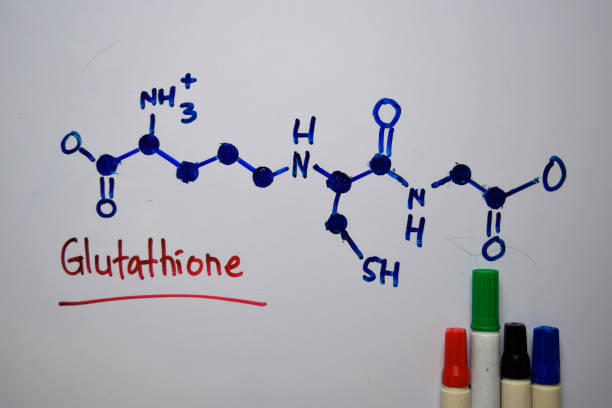
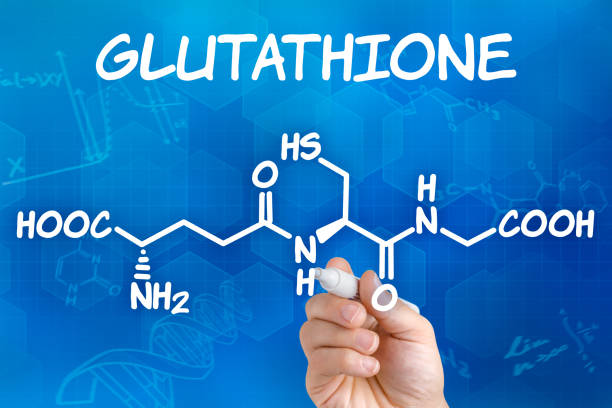
Glutathione is a tripeptide molecule composed of three amino acids: glutamic acid (glutamate), cysteine, and glycine, linked together in a unique γ‑glutamyl‑cysteinyl‑glycine sequence. This special peptide linkage between the side chain of glutamate and cysteine helps distinguish glutathione from ordinary peptides and contributes to its stability as a cosmetic raw material.
Why Reduced Glutathione (GSH) Matters
In the world of glutathione raw materials, purity and bioactivity are paramount. We focus specifically on Reduced Glutathione (GSH). In its reduced state, the molecule is biologically active and ready to donate electrons to unstable free radicals.
- Superior Bioavailability: GSH is the form most readily utilized by human skin cells.
- Self-Regenerating Power: One of the most remarkable functional properties of GSH is its ability to “recycle” other antioxidants, such as Vitamin C and Vitamin E, extending their efficacy within a cosmetic formula.
Advantages as a Functional Cosmetic Raw Material
As a high-grade glutathione raw material, it offers several distinct advantages for chemical formulators:
- High Stability: Modern processing ensures that our GSH remains stable in various pH ranges common in skincare.
- Deep Cellular Protection: It doesn’t just sit on the surface; it helps protect the cellular DNA from UV-induced damage.
- Multi-Pathway Brightening: It addresses skin tone by inhibiting tyrosinase activity and shifting melanin production from dark eumelanin to lighter pheomelanin.
Mechanisms of Glutathione in Skin Brightening
Glutathione brightens skin mainly by inhibiting melanin formation and shifting pigment toward a lighter type in the epidermis. It is widely used in brightening formulas because it can act on several key steps of the pigmentation process to help achieve a more even, luminous skin tone.
Inhibition of tyrosinase and melanin synthesis
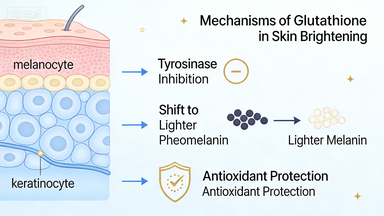
Glutathione interferes with the activity of tyrosinase, the rate‑limiting enzyme that converts tyrosine into dopa and dopaquinone, the first steps in melanin production. By reducing tyrosinase activity, glutathione lowers the overall amount of melanin synthesized in melanocytes, which gradually leads to lighter and less noticeable pigmentation in the skin. In addition, glutathione can chelate metal ions (such as copper) that are essential cofactors for tyrosinase, further contributing to a skin whitening mechanism at the enzymatic level.
Shift in melanin type toward lighter pheomelanin
Beyond simply reducing melanin quantity, glutathione is also associated with a qualitative shift from darker eumelanin to lighter pheomelanin. Through its interaction with dopaquinone and its thiol group, glutathione can promote the formation of sulfur‑containing, yellow‑reddish pheomelanin rather than brown‑black eumelanin. This change in melanin type supports a brighter, more translucent complexion and makes glutathione particularly attractive wherever “melanin inhibition” and “pigmentation control” are key marketing claims.
Reduction of oxidative stress–induced hyperpigmentation
Oxidative stress from UV exposure, pollution, and inflammation can stimulate melanocytes and trigger excess melanin production, leading to dark spots and uneven tone. As a tripeptide antioxidant, glutathione neutralizes reactive oxygen species and helps maintain redox balance in skin cells, thereby reducing the signaling pathways that drive post‑inflammatory hyperpigmentation and photo‑induced darkening. By lowering oxidative damage in the epidermis, glutathione helps prevent new pigment spots from forming and supports a clearer, more uniform appearance over time.
Scientific basis for brightening formulations
From a formulation perspective, glutathione works synergistically with other brightening agents such as vitamin C, niacinamide, and tranexamic acid to build multi‑pathway whitening systems. It targets melanin synthesis via tyrosinase inhibition, modulates melanin quality by favoring pheomelanin, and protects the skin environment by limiting oxidative triggers of pigmentation. Together, these mechanisms underpin the scientific rationale for using glutathione in modern skin brightening products, making it a valuable active for serums, essences, creams, and ampoules that focus on safe, gradual, and multi‑dimensional brightening effects.
Anti-Aging Benefits of Glutathione in Skincare
Glutathione acts as a powerful anti-aging antioxidant in skincare by neutralizing free radicals before they can damage skin cells and structural proteins. By reducing this oxidative burden, it helps keep the skin looking smoother, firmer, and more radiant over time.
Protection from oxidative stress and cell damage
- Glutathione scavenges reactive oxygen species generated by UV radiation, pollution, and daily environmental stress, helping to protect keratinocytes and fibroblasts from oxidative injury.
- This protection slows the cascade of damage that leads to dullness, rough texture, and visible signs of photoaging such as uneven tone and surface roughness.
Slowing visible skin aging
- By maintaining a healthier redox balance in the skin, glutathione helps delay the onset of fine lines and early wrinkles that are often triggered by chronic oxidative stress.
- Regular use in topical formulas can support a more youthful appearance, complementing sunscreen and other anti-aging ingredients in a complete routine.
Collagen and elastin preservation
- Oxidative stress accelerates the breakdown of collagen and elastin through activation of matrix metalloproteinases (MMPs); glutathione helps limit this process by reducing oxidative triggers.
- By helping to preserve collagen fibers and elastin networks, glutathione supports better skin density and structural integrity, which are essential for firmness.
Improvement of elasticity and fine lines
- With better protection of collagen and elastin, the skin can maintain improved elasticity and resilience, making expression lines and fine wrinkles appear less pronounced.
- In anti-aging formulations, glutathione is often positioned as a wrinkle reduction ingredient that supports smoother texture, more elastic skin, and a brighter, healthier-looking complexion when used consistently alongside moisturizers and UV protection.
Applications of Glutathione in Cosmetic Formulations
Glutathione is widely used in modern skincare formulations as a multifunctional brightening and anti-aging active, especially in products that target dullness, uneven tone, and early wrinkles.
Serums and face creams
In brightening serums, glutathione is typically incorporated as a key active to support a clearer, more even complexion, often combined with vitamin C, niacinamide, arbutin, or tranexamic acid for synergistic whitening effects. In day and night creams, it can be used at lower to moderate levels to provide long-term antioxidant protection, improve skin tone uniformity, and enhance anti-aging benefits such as firmness and radiance.
Masks and professional/medical-grade skincare
Sheet masks, wash-off masks, and sleeping masks often feature glutathione for intensive brightening and revitalizing care, delivering a concentrated dose in a short application time. In professional and medical-grade skincare (such as clinic-branded post-treatment products), glutathione is frequently positioned to support recovery after procedures, help reduce post-inflammatory hyperpigmentation, and protect stressed skin from oxidative damage.
Whitening lotions and functional skincare
Body and facial whitening lotions use glutathione to help reduce the appearance of dark spots and overall pigmentation, providing a more uniform tone on larger skin areas when used consistently. In functional skincare products—such as anti-spot essences, tone-up creams, and multi-correction fluids—glutathione is combined with UV filters, moisturizers, and barrier-supporting ingredients to deliver brightening, hydration, and protection in one formula.
Safety Profile and Regulatory Considerations
As a globally traded cosmetic ingredient, the safety and regulatory compliance of Glutathione are paramount for brand owners and manufacturers. While it is naturally occurring in the human body, its application in topical products is subject to rigorous standards to ensure consumer safety and product efficacy.
Safety Research Overview
Extensive toxicological studies and clinical trials have established that topical glutathione is generally recognized as safe (GRAS) for cosmetic use. Unlike aggressive bleaching agents like hydroquinone, Glutathione provides a non-cytotoxic approach to skin brightening. Research indicates that concentrations of up to 2% in leave-on products (such as lotions and serums) are well-tolerated by most skin types, showing no significant adverse effects or irritation in long-term dermatological studies.
Global Regulatory Status
European Union (EU): Included in the CosIng database as a skin-conditioning and antioxidant agent. It is widely used in compliance with the EU Cosmetics Regulation (EC) No 1223/2009.
In the United States, topical cosmetics are permitted under the FDA regulations. Manufacturers must ensure that marketing claims do not classify the product as a “drug” (e.g., claiming to treat a medical condition).
China: Listed in the IECIC (Inventory of Existing Cosmetic Ingredients in China), making it a stable and approved choice for brands looking to enter the massive Chinese beauty market.
Market Trends and Growing Demand for Glutathione in Cosmetics
The global beauty landscape is undergoing a significant shift toward “clean science” and high-efficacy ingredients. Within this movement, glutathione market trends indicate a robust upward trajectory. Valued at over USD 250 million in 2024, the global market is projected to grow at a CAGR of nearly 7-10% through 2032, with the cosmetic and personal care sector being one of the primary engines of this expansion.
Surging Demand for Advanced Whitening and Radiance
As consumers in key markets like the Asia-Pacific (which dominates over 50% of the skin-lightening market), North America, and Europe move away from harsh bleaching agents, the whitening ingredient demand for safer, bio-active alternatives like Glutathione has spiked.
Conclusion
Glutathione has become a highly promising ingredient in the cosmetic industry, offering scientifically supported benefits in skin brightening and anti-aging applications. Its strong antioxidant capacity, ability to regulate melanin production, and protective effects against environmental stressors make it an attractive choice for modern skincare formulations. As consumer demand continues to shift toward effective, safe, and multifunctional cosmetic ingredients, glutathione is expected to play an increasingly important role in next-generation beauty and personal care products.
Runtai Chemical is committed to supplying high-quality glutathione raw materials designed to meet the evolving needs of cosmetic manufacturers worldwide. With strict quality control standards, stable production capabilities, and professional customer support, Runtai Chemical aims to help partners develop innovative and competitive skincare products.